
First Marathon Story: "Fail Forward": Finding Strength Through a Marathon Gone Wrong w/ Barry Scruggs

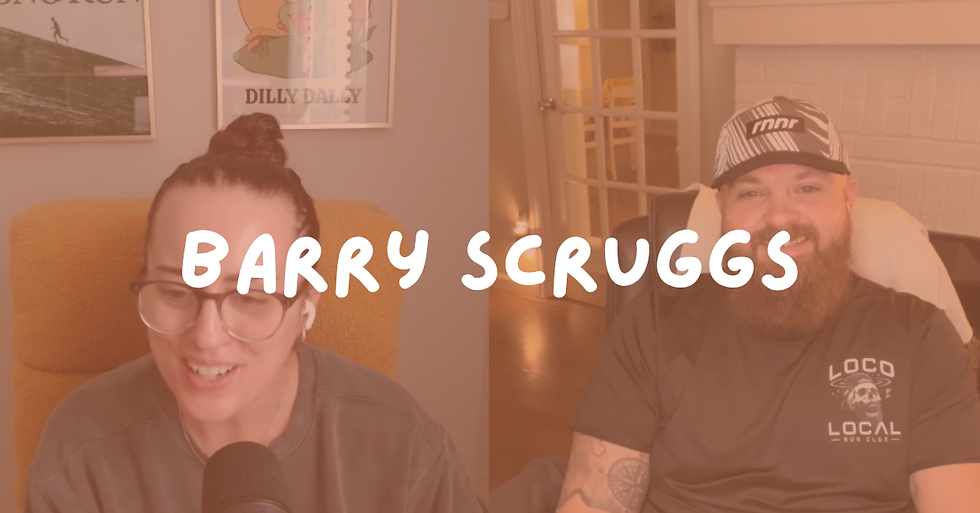
Jumping in Head First
Barry started running about four years ago. He and his wife struggled with fertility issues, and had "let themselves go" settling into a happy marriage together first, and then suffering the disappointment of being unable to have kids (once they both started running, they ended up pregnant naturally).
The kids they had dreamed of for so long put their running journey on hold, and Barry says they "let themselves go" again. But then it was four years ago that he and his wife decided they needed to put their health first. True to form, Barry and his wife signed up for a Spartan race (The Super in Black Mountain, NC), and it was "baptism by fire."
Barry also had his eye on the Around the Crown 10K, and they both signed up with a few months to prepare. He found a training plan online, and was off to the races.
The beginning days were tough; Barry was overweight, shoes were a struggle, and he wasn't quite sure what he was doing. But they "worked their butts off" ahead of the race, and knocked out the 10K. They were hooked.
Proving Your Mind Wrong
Barry spent a lot of silent miles, enjoying his new fitness and going by feel most days. He ended up running a half marathon with a backyard ultra (where cramping and nutrition betrayed him), but mostly he was enjoying the journey with no race pressure. The ultra helped him realize that his nutrition needed work, and he started making a conscientious effort to adjust his fueling.
Just after Father's Day, Barry decided he wanted to commit to running a marathon. The Charlotte Marathon was coming up in November, and he was tired of saying "some day." He had run 20 miles on Memorial Day, and he felt ready to go. He signed up and was off to the race(s).
Barry downloaded the Charlotte Marathon training plan, but trusted his routine too. He was already running 28 - 35 miles per week, and kept his Monday-Thursday running schedule with long runs on Saturday. His longest run leading up to the marathon was 22 or 23 miles, before easing into the taper.
Unfortunately, Barry ended up with the flu two weeks before the race, with only a week left before the race where he was feeling good. And then he got the "taper flu" and couldn't even talk the Monday before the race. He started getting worse, short of breath, by Wednesday, went to the doctor, and got bronchitis that developed into pneumonia. It felt like everything was being ripped out from under him.
But Barry felt like he had to do it. And with antibiotics and an inhaler, he headed to the start line.
"I'm Going To Do This Thing."
Barry started at a good pace through the halfway point, but about every mile-and-a-half he had to use the inhaler. He was behind his goal pace, but he was chipping away at the mileage. At Mile 14, the hills showed up, and he started to feel worse. Stabbing, burning sensation in his lungs started. And then he started to hear the sweepers coming behind him by Mile 16. The discouragement set in.
He chased the sweeper trailer, ahead of the race officials collecting cones. He committed to sticking with the trailer, about with the six-hour pacers. Around Mile 19, he started to feel unsteady on his feet. He stopped, letting the trailer slowly inch away from him. He called his wife in a panic: he couldn't breathe, he couldn't see. His wife headed out to pick him up, while Barry headed to a spot where he could be picked up. A race official let him know the cutoff time was approaching, and the finish line might not even be there when he was able to get there.
But Barry kept shuffling. At Mile 19, he told another race official that he was just trying to make it back to civilization. They took a photo of his bib number, and Barry kept going.
The race signs were gone, the traffic was back. Barry pulled up the race map on his phone to keep going. On his way to Mile 20, his wife called, and her phone was dying. He just kept going.
With a 10K left, he was on a greenway just off the main street. Barry saw his wife running towards him, and he felt all of the emotions of the day wash over him. His wife asked "what do you want to do?" And he answered, "would you be mad if I finished this?" She answered, "absolutely not."
He and his wife shuffled along. As he approached Truist Field, he started to feel excited to finish the race, regardless of time. People stopped packing up cheer stations to cheer him on.
While the arch was gone, the timing mat was gone, there was a purple line on the street, and the race ambassador stood up with a medal in her hand, screaming for him to reach the finish line. He pushed himself through the final steps and crossed the finish line a marathoner.
Lessons Learned
Do the silent work that will eventually show up.
Pull yourself out of the depths and keep it going.
When the kick in the teeth happens, just keep pushing forward.
Want to hear Barry tell the story himself? Listen to the full episode now: "Fail Forward": Finding Strength Through a Marathon Gone Wrong w/ Barry Scruggs— available wherever you get your podcasts.
Listen to my most recent mini episode: Why I Program Speed Work (Mini Episode)
Download the guide: 5 Marathon Mistakes That Led To Injury (Or made it worse)
Want more stories like this in your inbox? Subscribe to The Rundown newsletter!
Follow along with the show:
👣 Personal IG/TikTok: @tay.says / @taysays
🎙️ Podcast IG/TikTok: @myfirstmarathonpod
📺 YouTube: @MyFirstMarathonPodcast
🌐 Website & extras: myfirstmarathon.co & myfirstmarathon.co/resources
Schedule a coaching consultation call - https://app.acuityscheduling.com/schedule/96966263/appointment/85354440/calendar/12986861?appointmentTypeIds[]=85354440


Comments